Nest protection concept

Turtle Nest Watch

A turtle nest can become urgent in a single night.

Illustrative schematicProposed nest-protection system
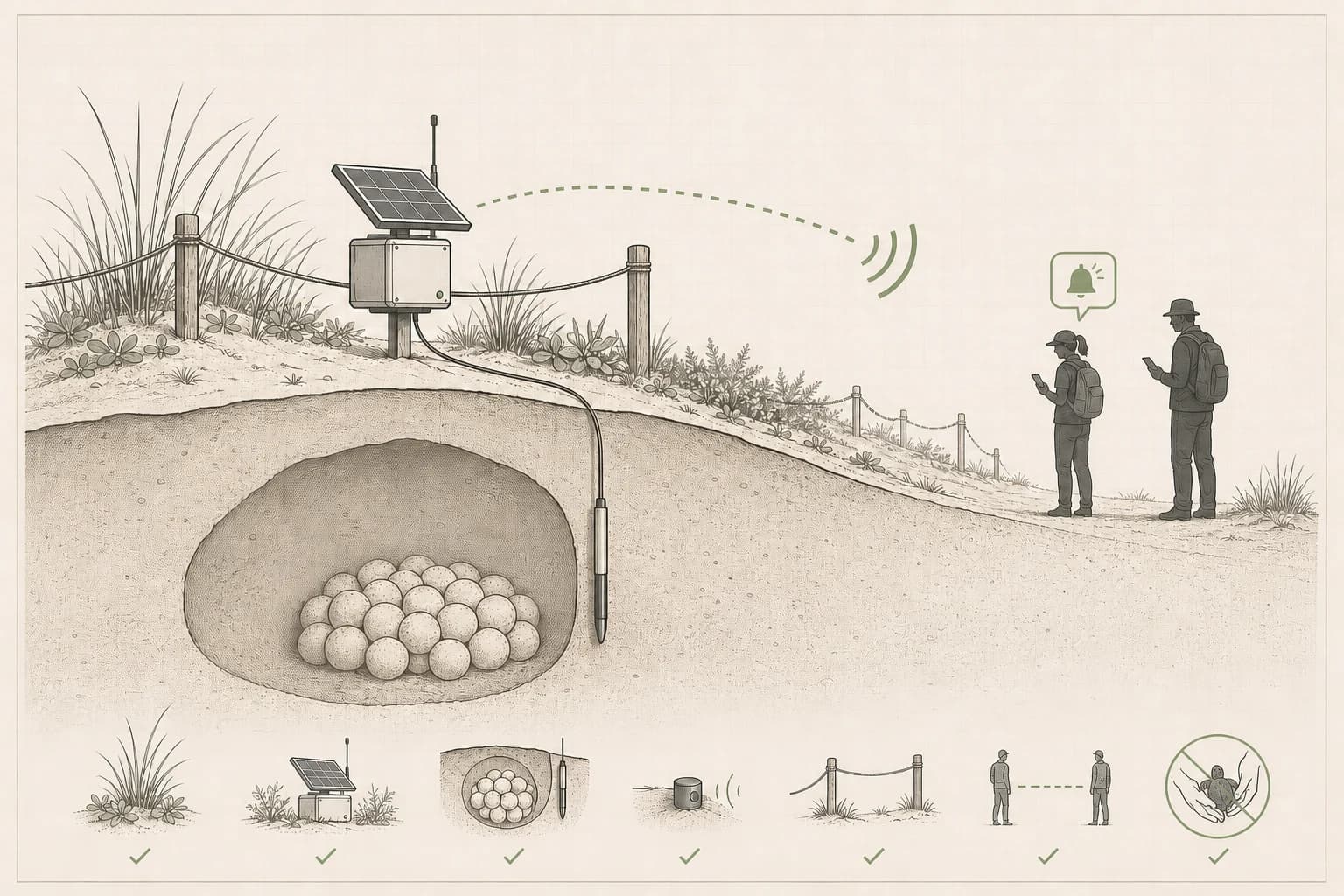
Illustrative beach cross-section showing a solar field unit connected to sensors beside a buried turtle nest, with an alert reaching two trained field workers.
  1. Protected nest
  2. Low-impact sensors
  3. Solar power
  4. Local review
  5. Trained volunteers
A proposed arrangement for low-impact sensing, local review, and trained volunteer alerts. This is not a deployed nest monitor or field result.

Turtle Nest Watch would use carefully approved temperature, movement, and limited visual signals to help trained local teams prepare, while keeping nest locations private and conservation protocols in control.

The most important moment often happens at night

Sea turtle nests can sit quietly for weeks, then suddenly become urgent. Temperature exposure matters. Predators, flooding, beach traffic, artificial lights, and human disturbance can all affect outcomes.

Hatching often happens at night or during windows when volunteers are stretched thin.

  • Is this nest experiencing dangerous heat exposure?
  • When is emergence likely?
  • Has movement started below the sand?
  • Should volunteers prepare for protection tonight?

A nest monitor built for community stewardship

Turtle Nest Watch proposes a solar-powered field unit with battery backup and a limited set of signals approved for the species, beach, and local protocol.

Any field trial would be installed, reviewed, and recovered by trained local teams under conservation permission.

Prepare protection at the right time

If a field trial can identify useful changes without disturbing the nest, trained volunteers could prepare protection and document outcomes at the right time.

The local conservation team would decide whether those signals strengthen protection without encouraging staging, handling, crowding, or disturbance.

Intended use

Practical questions local teams could use it to explore

Each example begins with a field need that local teams would need to shape, test, and review before any wider use.

  1. Heat exposure watch

    Track nest temperature exposure through incubation so teams can see when heat pressure is becoming a concern.

    Intended record: Temperature records and exposure summaries for authorised local conservation review.

  2. Hatch-window alerts

    Use movement, vibration, and visual cues to understand when a nest may be becoming active.

    Intended record: A readiness signal that helps volunteers prepare protection at the right time.

  3. Nest activity context

    Monitor context around predators, flooding, beach traffic, artificial light, and disturbance without repeated site visits.

    Intended record: Reviewed event notes that support nest protection and beach management decisions.

  4. Volunteer coordination

    Coordinate trained volunteers when a nest needs attention, especially during night windows or stretched field schedules.

    Intended record: Private alert logs and watch schedules that authorised teams can review after each emergence window.

Concept operating flowHow a careful field trial could work
  1. Confirm local permission
  2. Install with trained teams
  3. Review limited signals
  4. Prepare volunteers
  5. Record the outcome
A proposed sequence from authorised installation to local review and protection planning. Conservation protocols would govern every step.

Proposed system

Designed to be understood, maintained, and adapted

  • Low-power field unit

    A small solar and battery field unit intended for approved placement near a discovered nest under local conservation protocols.

  • Approved nest signals

    Calibrated temperature, movement, or vibration sensing selected and positioned by the authorised conservation team.

  • Limited visual context

    A discreet camera view for surrounding context, using wildlife-appropriate lighting or non-visible illumination where permitted.

  • Protected volunteer alerts

    Small, private alerts through the local connection approved for notifying trained volunteers.

  • Local record and recovery

    A local review and recovery checklist covering signals, watch notes, protection actions, outcomes, removal, and maintenance.

Useful records

Intended to leave a clear record for local decisions

If field trials support the approach, Turtle Nest Watch would help teams review observations, decisions, and changes over time in one place.

  • Permitted temperature, movement, and limited visual context for authorised local review.
  • Readiness notes, private alerts, and volunteer plans linked to reviewed signals rather than exposed nest locations.
  • Protected nest outcomes and seasonal summaries that help local teams compare conditions without publishing sensitive sites.
Concept review viewPossible protected nest record
  1. Temperature context
  2. Movement signal
  3. Readiness note
  4. Volunteer plan
  5. Protected outcome
A proposed local review view for limited nest signals, volunteer readiness, and outcome notes. It contains no nest location, field data, or measured result.

Safeguards

Local control must shape every field trial

A responsible trial would define who controls the work, what is safe to collect, and how the system can be maintained or stopped locally.

  • Install only with trained and authorised local teams.
  • Minimize disturbance to nests, turtles, hatchlings, and beach habitat.
  • Avoid lighting or camera behaviour that changes hatchling orientation.
  • Keep nest locations and monitoring records under local control where poaching, crowding, or disturbance is a risk.
  • Follow local conservation protocols for handling, relocation, shading, and public access.

What support makes possible

What funding covers

Support funds the practical work needed to move from a useful idea to one responsible, locally reviewed field trial.

  • Authorised conservation partner time to set the species protocol, monitoring question, volunteer plan, and useful local record.
  • Permissions, disturbance limits, nest-location protection, and independent field review before and during a trial.
  • A low-power prototype, approved sensor calibration, careful field preparation, and post-season equipment recovery.
  • Training for authorised staff and volunteers, maintenance guidance, protected outcome records, and local handoff.

What comes next

Field partners and funders can shape a responsible first trial

The next step is a bounded field question, clear safeguards, and a local team with the time and authority to review the work.

  • Authorised conservation teams and local stewards

    Choose whether monitoring is appropriate, set the species protocol and disturbance limits, protect nest locations, prepare volunteers, and decide how records may be used.

  • Turtle researchers and species specialists

    Review sensor placement, calibration, heat exposure, emergence signals, and seasonal comparisons against accepted local conservation practice.

  • Field technicians and technical builders

    Build low-power sensors, rugged solar nodes, wildlife-safe context views, private alerts, and repairable field tools under the conservation protocol.

Next step

Fund a conservation-led nest trial

Funding would cover authorised partner time, species-specific safeguards, careful prototyping and calibration, independent field review, volunteer guidance, and recovery after the nesting season. A trial would proceed only if the local conservation team approves the method and disturbance limits.