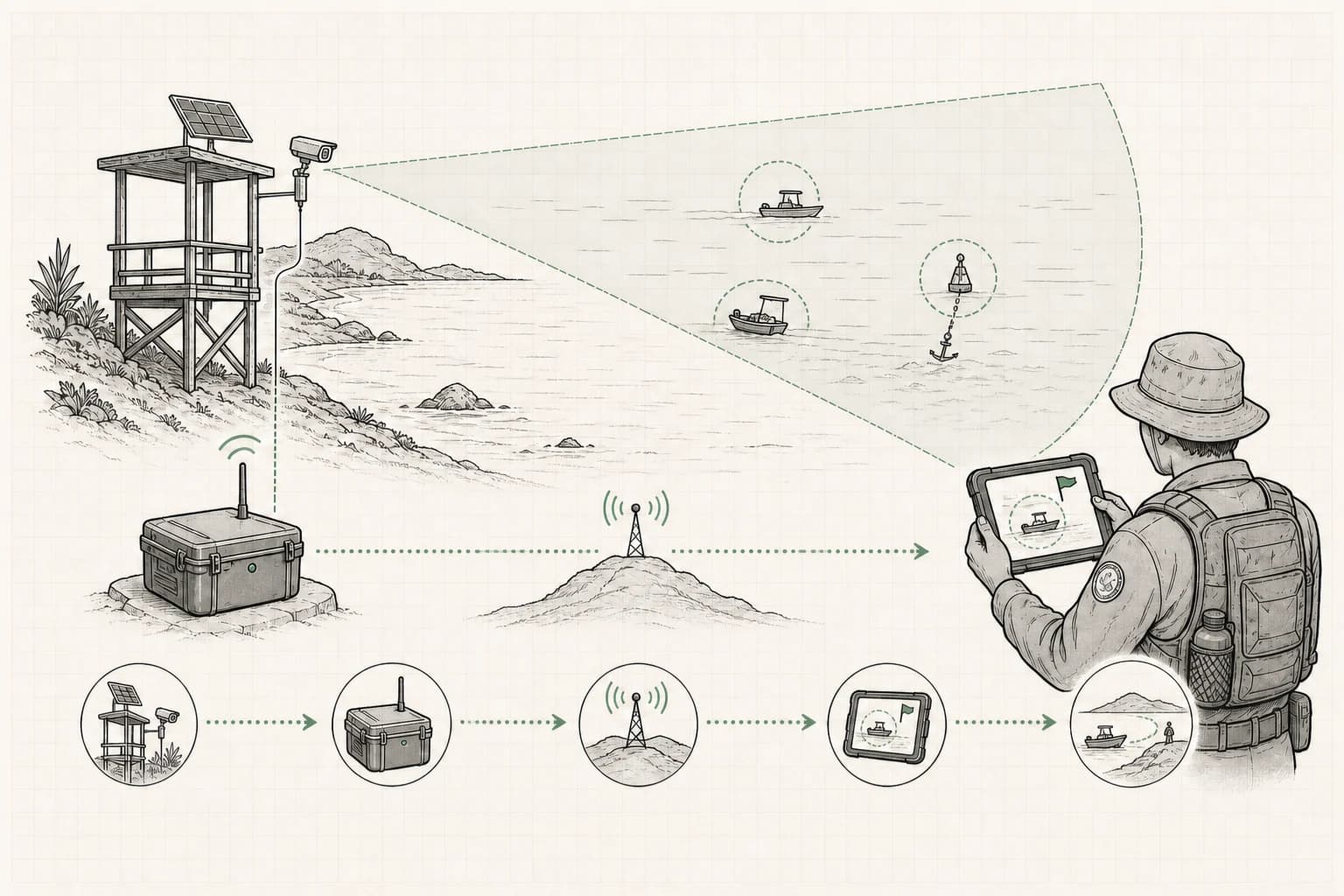
Marine park awareness concept

Marine Park Lookout

A small ranger team cannot watch protected waters all day.

Illustrative schematicProposed marine park awareness system
Illustrative coastal lookout showing a solar-powered camera, a bounded view across boats and an anchorage, a radio link, and a ranger reviewing an alert on a tablet.
  1. Defined park zone
  2. Watch point
  3. Local processing
  4. Human review
  5. Local response
A proposed arrangement for a solar-powered watch point, local review, and low-bandwidth alerts. This is not a deployed monitoring site.

Marine Park Lookout would observe one locally defined zone from a solar-powered shore point, send a small event summary through available local connections, and leave every decision with park staff or community monitors.

Protected zones are hard to protect when nobody can see them

Many marine parks are managed by small teams responsible for large, dynamic coastal areas. Activity changes by season, weather, tide, tourism, fishing pressure, time of day, and local events.

A ranger cannot be everywhere. A patrol boat cannot run all day. A fixed camera system may be too expensive, too power-hungry, or dependent on infrastructure that does not exist.

The result is a visibility gap. Managers may hear about violations late, miss patterns entirely, or lack the evidence needed to improve zoning, education, and patrol planning.

A practical lookout for one agreed area

Marine Park Lookout proposes a solar-powered camera point for observing one agreed area from a ranger station, pier, lookout, or authorised community facility.

Local processing would flag a possible event and send a small summary through the connections available at that site.

Human review stays at the centre

A trial would flag possible events for rangers or community monitors to review. It would not identify private individuals or make an enforcement decision.

The local team would control the zone, rules, access, retention, and every response that follows.

Intended use

Practical questions local teams could use it to explore

Each example begins with a field need that local teams would need to shape, test, and review before any wider use.

  1. Protected zone watch

    Watch no-take zones, restoration areas, and reef boundaries when patrols cannot be present all day.

    Intended record: A reviewable activity record showing when sensitive zones are entered and what happened next.

  2. Anchoring pressure

    Identify anchoring-like activity near reef flats, seagrass beds, moorings, or restricted anchorage areas.

    Intended record: Event summaries that help teams decide where signage, moorings, or patrol visits are needed.

  3. Night activity

    Flag unusual lights, vessel movement, or late activity where local rules make timing important.

    Intended record: Night-event records that can be reviewed by people before any response is escalated.

  4. Vessel patterns

    Track broad vessel movement through channels, beaches, tourism areas, and marine park boundaries.

    Intended record: Pattern summaries by time, tide, season, and location for better park planning.

Concept operating flowHow a local alert could be reviewed
  1. Agree the zone and rules
  2. Observe surface activity
  3. Flag a possible event
  4. Review locally
  5. Record the response
A proposed sequence from observing a defined zone to local review and a proportionate response. A field partner would set every rule and threshold.

Proposed system

Designed to be understood, maintained, and adapted

  • Solar lookout point

    A solar-powered camera point with a serviceable enclosure and mount for an agreed view from land or an authorised community facility.

  • Local activity review

    Local processing that flags broad vessel, anchoring, movement, or light patterns without sending a continuous high-bandwidth stream.

  • Zone rules

    Local park zones, permitted areas, seasonal rules, quiet hours, confidence thresholds, and review settings.

  • Alert routing

    LoRa, cellular, Wi-Fi, or local mesh routing depending on what the community has available.

  • Human decision record

    A simple local view where authorised people confirm context, choose a response, correct errors, and record maintenance needs.

Useful records

Intended to leave a clear record for local decisions

If field trials support the approach, Marine Park Lookout would help teams review observations, decisions, and changes over time in one place.

  • Locally reviewed event notes with the time, agreed zone, broad activity, context, and decision.
  • Daily or weekly pattern summaries for park managers and authorised community groups.
  • An alert and response history that helps teams review education, signage, anchorage, and patrol decisions.
Concept review viewPossible local activity record
  1. Zone context
  2. Possible event
  3. Review status
  4. Decision note
  5. Response record
A proposed review view for zones, event context, decisions, and response notes. It contains no surveillance footage, field data, or measured result.

Safeguards

Local control must shape every field trial

A responsible trial would define who controls the work, what is safe to collect, and how the system can be maintained or stopped locally.

  • Classify activity, not private individuals.
  • Use human review before escalation decisions.
  • Make local governance and data access explicit.
  • Keep sensitive species and enforcement details protected.
  • Configure rules around local law, culture, and conservation practice.

What support makes possible

What funding covers

Support funds the practical work needed to move from a useful idea to one responsible, locally reviewed field trial.

  • Marine park and community-monitor time to define one zone, one useful alert, and the response decisions it may support.
  • Privacy, local governance, data-access, and sensitive-conservation safeguards agreed before installation.
  • A rugged solar lookout point, local processing, a suitable local connection, installation planning, and review tools.
  • Ranger and community-monitor training, power and lens checks, repair notes, maintenance, and local handoff.

What comes next

Field partners and funders can shape a responsible first trial

The next step is a bounded field question, clear safeguards, and a local team with the time and authority to review the work.

  • Marine park teams and community monitors

    Choose the zone, define normal local activity, set review and response rules, and decide when education, signage, patrols, or no action is appropriate.

  • Local governance and conservation partners

    Set privacy boundaries, protect sensitive species and enforcement details, and review whether a trial remains proportionate under local law and conservation practice.

  • Makers and field technicians

    Build rugged enclosures, low-power processing, camera mounts, available local links, and simple review tools that can be maintained near the park.

Next step

Fund a carefully bounded park lookout

Funding would cover partner-led zone and privacy rules, a rugged solar prototype, installation planning, local review tools, training, and field maintenance. A first trial would test one useful alert type in one defined area before any wider use.